
Judd Lander on Karma Chameleon, AI & Drinking Tea with Spice Girls

Updated: Mar 9
Judd Lander is a renowned UK session harmonica player, known for his work on the massive Culture Club hits 'Karma Chameleon' and 'Church of the Poison Mind'. But his career stretches far beyond that - from major pop sessions to orchestral recordings, television work, and collaborations with legendary musicians. With over 2,000 recording sessions, he has played with Paul McCartney, The Spice Girls, The Beach Boys, Tina Turner, Annie Lennox, Madness, and The Proclaimers.
In our conversation, Judd shares stories from inside the recording studio, talks about how classic solos were created, and reflects on what it takes to survive as a working session musician.
I hope you enjoy hearing directly from one of the great figures of modern harmonica!
Recording Karma Chameleon and Church of the Poison Mind
Q: Can you tell me a little about recording with Culture Club?
A: Let me tell you about Karma Chameleon and Church of the Poison Mind.
When I recorded them it was quite a bizarre situation, because I had a lot of different hats on at the time. My main job was actually heading Motown Records in the UK on the record division. Steve Levine, the producer of Culture Club, called me.
Steve and I went back years - we’d worked together at CBS Records when he was running the studio there. By this point he’d become a big producer. He rang me up and said:
“I’m recording a band called Culture Club. Bit of a madman singing, but I’d love you to come down. I'd like some harmonica on the tracks.”
So I said yes and popped down to the studio. It was Red Bus Studios, somewhere near Baker Street if I remember rightly.
It was very casual. George was there, Steve was there, and they played me the track. Steve had already sent me a cassette beforehand with the rough track, so I’d been throwing around a few ideas. When I got to the studio we experimented a bit and I said:
“Look, I’ve got this slightly silly little idea - sort of country meets pop.”
We played around with it and laid the track down. To be honest, it wasn’t an eventful session - quite quick really. I’d done a lot of live work on harmonica so I had lots of licks and ideas in my head.
Church of the Poison Mind was the first track I played on. It had that continuous refrain running through it. Then we did Karma Chameleon.
For some reason I was never a very “busy” harmonica player - not the sort who runs all over the instrument. I always liked vibrato and motivic playing, repeating and shaping ideas. I think that comes across in what I play. I’m not some suicidal kid tearing around the harp - I’m more of a cool, restrained player.
When the Song Took Off
Q: Did you immediately know Karma Chameleon would be a hit?
A: After the session it felt like just another job. I’d done many sessions, so I went back to the office and mentioned to people that I’d recorded with this band called Culture Club. Nice guys, interesting look.
I saw all the publicity with George and his outrageous look and I thought, Something’s going to happen here. You get a gut feeling sometimes.
And then the record just zoomed off the charts.
Suddenly I was doing Top of the Pops with them. George used to wind me up a bit - they’d dress me in ridiculous outfits. One show had an American theme and I was dressed as a Confederate soldier. Another time I was an Australian outback guy with a silly hat and a tail on it.
I always suspected the band were sitting there thinking:
“What can we dress him up in to make him look stupid?”
But it was great fun.
The track went massive all over the world. It really captured the moment, and I was very flattered that my harmonica part featured so heavily. It gave me a bit of notoriety for a while, which was nice.
Even now I can be walking through a supermarket with my daughter and the song comes on. She’ll look at me and say: "ker-ching!"
The Karma Chameleon Video
Q: The music video for Karma Chameleon is pretty famous too. How come you're not in it?
A: At the time Motown was celebrating its 25th anniversary in Pasadena, and because I was heading Motown UK I had to go over to Los Angeles. I’d also worked with Michael Jackson so there were a few people I wanted to see while I was there.
Meanwhile Culture Club were filming the video on a riverboat - Richard Branson’s boat, actually.
Because I was in LA they hired in another guy to mime the harmonica part in the video. He was a really cool black guy. And I have to tell people that's not me - it's just the stand-in they hired while I was away. He was wobbling the harmonica around a bit strangely but he fitted the part well enough!
Session Work in the 1970s and 80s
Q: Can you paint a picture of this era as a session musician?
A: Session work back then was very different. There weren’t many harmonica session players around. You had people like Mark Feltham who was very good, and Paul Jones from Manfred Mann, but there weren’t loads of us.
I ended up playing on all sorts of things - with Nazareth, Madness, even on a Beach Boys album.
It was a fascinating time because musicians were everywhere. You’d go into a studio and you might see incredible players walking in with guitars slung over their backs and big amplifiers - and then there was me turning up with a little bag of harmonicas.
I remember one session at Trident Studios where Jimmy Page was there. At that time he was still mainly working as a studio guitarist.
So there I was in the studio with Jimmy Page and a room full of amazing musicians. Everyone had big gear setups and I had this tiny case of harmonicas. It always amused people how small the instrument was compared to everything else.
On one session the arrangement was quite complicated and my harmonica part didn’t come in until quite a long way into the track.
We were all standing around the studio waiting for the moment. The producer said: “Right, Judd - you come in on bar such-and-such.”
But when the track started I realised it was going to be very hard to count exactly where my entrance was, because there was a long gap before it.
So we came up with a system where someone standing next to me would literally give me a little kick on the leg when it was time to play.
Sure enough, the track starts, everyone’s waiting… and suddenly I get this kick. That was my cue. It worked perfectly.
The Nazareth Bagpipe Story
Q: Did you play other instruments on any sessions?
A: There was a pub in Wardour Street called The Ship where musicians used to sit waiting for session calls.
One day a producer came out saying they needed bagpipes for a track. I didn’t play bagpipes - but I knew where there was a set in a music shop on Shaftesbury Avenue. The track was for Nazareth, on an album called Exercises, and the song was '1692 (Glencoe Massacre)'.
I got the bagpipes and went into the studio. I knew the basics because I’d been in a cadet force in Liverpool with the Scottish Highlanders.
But in the studio the humidity made the reeds expand, so the tuning drifted everywhere. Notes were flattening all over the place and it sounded like a cat being strangled. The band were crying with laughter.
Eventually they said:
“Do you play anything else?”
I said, “A bit of blues harmonica.”
So I ended up playing harmonica on about ten tracks for them - and they hid the bagpipes somewhere in the mix!
Learning from Harmonica Legends
Q: Were there harmonica players who influenced you early on?
A: One of my heroes was Shakey Horton. His playing was raw and powerful - a fantastic blues player.
When I was young in Liverpool in the 1960s I saw incredible blues musicians.
I remember Sonny Boy Williamson II coming over and playing at the Cavern with bands like the Yardbirds - with Eric Clapton and Jeff Beck.
I tried to talk to him backstage but he was far more interested in chatting with the women than with a long-haired kid asking about harmonica.
Eventually I bought him a bottle of whisky from the pub across the road and brought it backstage. That got his attention.
I asked him how he got that beautiful warm vibrato. He didn’t have many teeth and he used to put the harmonica right inside his mouth - it was fascinating to watch.
He showed me the vibrato technique and that really stayed with me.
I met the great Toots Thielemans. Toots was obviously one of the greatest harmonica players who ever lived. His tone and musicality were just extraordinary.
I went to see him perform, and during the show there was a woman sitting right next to me who was talking very loudly throughout the show. It was quite distracting and I was kind of irritated. After the show, Toots comes out and it turns out this woman is his wife!
Playing with Paul McCartney
Q: You've worked with Paul McCartney, haven't you?
A: I once got a phone call while I was working at Chrysalis Records. One of the girls in the office came in and said:
“Some idiot on the phone says he's Paul McCartney.”
She’d hung up on him!
It turned out he really was trying to get hold of me to play on a track at his studio in Peasmarsh.
When I arrived we were chatting outside and I saw scaffolding around a windmill.
I asked Paul what he was doing with it and he said Linda wanted to restore it so they could make their own bread. I told him there was a Tesco just up the road. He found that quite funny.
Paul once wrote a track that needed harmonica, and I remember it was a chromatic part initially which I must admit I did have trouble doing. And then he ended up just doing a bluesy piece at the very end of the track. But he loses me in the mix, and I think he let me come through at the very end out of a token gesture because it was a bad session.
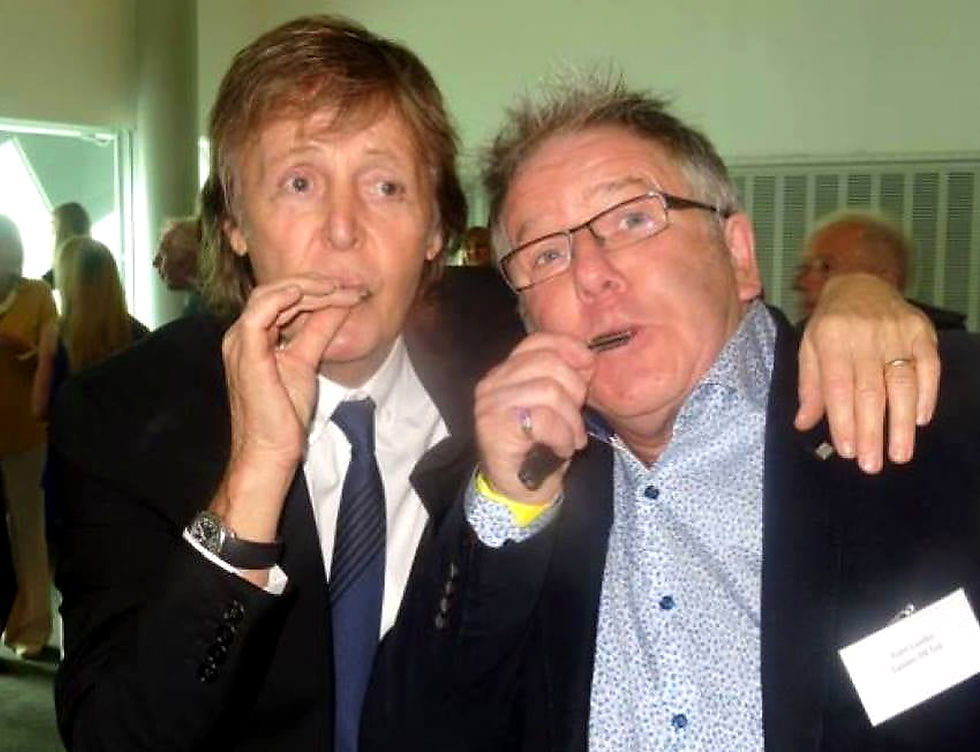
I once gave Paul a tiny harmonica. And every time we meet up, the two of us will do a little harmonica piece together, just to entertain the two of us. And we do that every year, and I've yet to catch him out without his harmonica!
The Spice Girls Story
Q: You recorded on a Spice Girls record - what was that like?
A: That was quite funny. I walked into the studio and asked one of the girls - not realising who she was - if she could make me a cup of tea. It turned out it was one of the Spice Girls. And she did make me a cuppa!
Later the record went massive worldwide.
I was at the Brit Awards working as a floor manager when I bumped into an old friend of mine in the crowd. He said he was there because his daughter was performing.
His daughter was Emma Bunton - Baby Spice!
I remembered her as a little girl going to auditions. It’s a small world in the music industry.
Working with ABBA
Q: You also mentioned working with ABBA?
A: I used to work quite closely with ABBA. I remember being in Sweden once and chatting with Björn over dinner about how things were going. This was around the time they’d had success with the musical 'Mamma Mia'.
In those days I used to have to drag them over to the UK to do all the big TV shows.
There was also a Musicians’ Union rule back then: if you came into the UK from abroad to promote a single, you had to re-record it within three hours in a British studio. In theory we had to record it again - but I’d usually just swap the tape and use the original!
When we were in the studio together I’d sometimes sit with Björn or Benny and we’d just play. I’d pick up the harmonica, he’d play something, and we’d improvise. That spontaneity was great.
But what struck me was their foresight. They were getting tired of constantly flying around the world promoting songs. Björn told me the musical was perfect because it could run in London while they stayed in Stockholm writing.
Then he mentioned they were working on something else - a huge visual show with digital versions of the band. At the time they were talking about a £95 million budget, which eventually became closer to £190 million.
Of course, that became ABBA Voyage - those digital avatars performing the show.
Thoughts on AI and the Future of Music
Q: You now work in music PR. Are you noticing any changes in the industry?
A: These days things are changing fast.
A client in America recently sent me a track with what sounded like a huge orchestra. I asked if it was the LA Philharmonic.
He said:
“No - it’s AI.”
Then I asked about his vocals. He said he didn’t sing - that was AI too. The whole track had been generated by AI.
I had to tell him honestly that, hand on heart, I’m a musician and it goes against everything I believe in.
But the reality is that technology is moving in that direction and we’ll probably have to learn to live with it.
What AI can’t replace is the energy of live performance - the moment when musicians interact and improvise together.
That human spark is something special.
The Beauty of the Harmonica
Q: What do you love most about the harmonica as an instrument?
A: The harmonica is a strange instrument when you think about it.
You’ve only got a handful of notes - basically the white notes of the piano. You have to create the other notes yourself through bending and expression.
That’s the fun of it. With this tiny little instrument you can create so much emotion.


.png)