
Harmonica Tunings Guide: Top Alternate Tunings Explained (Paddy, Minor, Wilde & More)

Updated: Aug 18

At some point, most harmonica players start to wonder: "What alternate tunings are out there - and should I try one?"
Maybe you've seen names like Paddy Richter, Natural Minor, or Wilde Tuning and you're curious what they actually do. Or maybe you feel like certain styles - especially melody playing or minor keys - are harder than they should be, and you're wondering if a different tuning might make things easier.
That's exactly what special harmonica tunings are for.
Alternative harmonica tunings completely change:
What notes are available
How scales are laid out
Which styles feel natural to play
And each harmonica tuning reshapes the instrument in a different way: some make melodies easier, some are built for blues or minor keys, others completely rethink how the notes are laid out.
To compare tunings quickly, try my easy-to-read Tunings Comparison Chart
What is included in these harmonica tuning charts?
This harmonica tunings guide covers the most important tunings for 10 hole diatonic harmonica - from standard Richter to modern innovations - so you can choose the right setup for your playing. And just as importantly, you'll learn how they all relate back to standard Richter tuning, so you can make informed decisions without feeling like you're starting from scratch.
The most common harmonica tunings are Richter, Paddy Richter, Natural Minor and Country tuning. You will find all of those, plus more than 20 tunings for diatonic harmonica in this guide. No list can be comprehensive (since there are almost infinite ways you could tune a harmonica) but I have tried to include all the popular alternate tunings and lots more besides.
For each chart I have included blow and draw notes plus all available draw-bends and blow-bends. I have also included overblows and overdraws (collectively called overbends) where they enable an additional note. I have included these for completeness although bear in mind that several of these tunings are intended to avoid the need for using overbends. I have not included overbends giving you notes that are more easily achievable as a bend or natural note. This is to avoid the charts becoming overwhelming or confusing.
Tap here to select a tuning:
Alternate Harmonica Tunings - Note Charts
1. Standard Richter Tuning (The Foundation)

This is where almost everything begins. Richter tuning is used on the vast majority of diatonic harmonicas and underpins most blues, rock, and folk playing.
Why it works:
Built around a major chord (blow notes)
Draw notes create tension and movement
Enables expressive bending techniques
👉 Best for: blues, folk-rock, most beginners
If you’re new to diatonic harmonica, check out my Beginner Harmonica Guide
Richter is considered the default, standard tuning against which others are compared.
If you'd like to buy a Richter-tuned harmonica, I recommend the Hohner Special 20. Here are some Amazon links (I receive a small commission at no extra cost to you if you buy through one of these links; you don't have to use these links or buy these harmonicas):
2. Richter-Based Modifications (Easy Upgrades)
These special tunings make small changes to Richter for big musical benefits.
Paddy Richter (Melody Friendly)

This tuning was invented by Brendan Power for playing Irish folk tunes more easily, but it can also be very useful for other styles of music. On the diagram I have highlighted the one note (3 blow) that is different from standard tuning.
What it does:
Raises the 3 blow note a tone
Makes traditional Irish melodies easier.
👉 Best for: folk, Irish music, melody playing
Learn more about Paddy Richter tuning → Paddy Richter Harmonica Guide
You can order Paddy Richter harmonicas direct from the Seydel Store.
Country Tuning (aka Major Seventh)

Country tuning has been used famously by Nashville harmonica legend Charlie McCoy for many years. On the diagram I have highlighted the one note (5 draw) that is different from standard tuning. This helps make second position major scale melodies much easier because you no longer require an overblow.
Features:
Raises the 5 draw note
Makes major scales in 2nd position much easier
👉 Best for: country, melodic cross harp
Learn more about Country Tuning → Intro to Country Tuned Harmonicas
If you'd like to buy a Hohner Special 20 harmonica in country tuning, here are some Amazon links (I receive a small commission at no extra cost to you if you buy through one of these links):
Lee Oskar Melody Maker

Lee Oskar's Melody Maker tuning is a bit like an extended combination of the Paddy Richter and Country tunings we have seen above. I have highlighted the three notes (3 blow, 5 draw, 9 draw) that are different from standard tuning. This tuning is optimised for major playing in 2nd position and Lee Oskar's Melody Maker harmonicas are labelled to reflect this.
👉 Best for: clean melodic playing
Please note: I have included overbends on this tuning chart, but the tuning is made by Lee Oskar Harmonicas, whose harps are notoriously bad at overbending so I do not recommend overbending on this harmonica. I have included the notes for completeness because technically they are possible.
Learn more about the Melody Maker → Free Melody Maker Guide
If you'd like to buy a Lee Oskar Melody Maker harmonica, here are some Amazon links (I receive a small commission at no extra cost to you if you buy through one of these links):
Lee Oskar Melody Maker:
Easy 3rd Tuning

Easy 3rd Tuning makes it easier to play minor scale melodies in the lower octave, because it eliminates the need to include a double-bend on hole 2 in third position. Originally based on an idea by Dale King, this is used widely by Joel Andersson for playing Irish melodies. It is also useful for playing reggae because of its combination of C major and D minor. On the diagram I have highlighted the two notes (2 draw, 3 draw) that are different from standard tuning.
Features:
Makes 3rd position (minor playing) more accessible
Reduces reliance on tricky bends in lower octave
👉 Best for: minor blues, modal folk tunes, reggae
Want to to learn more about the Easy 3rd Tuning? → Easy 3rd Tuning - Full Guide
You can order Easy Third tuned harmonica direct from the Seydel Store.
Todd Parrott Tuning

Todd Parrott's harmonica tuning lowers the seven draw by a semitone - you can see this note highlighted on the diagram. I have also seen this called "Flat Tenth" Tuning which does have a logic to it but I think it can be misleading as a label. This tuning means you can play the minor "blue" third in second position in the middle octave without needing to overblow. You can get the newly missing note via a blowbend on hole 7.
Major Cross Tuning

Developed by Tony Ayers for easy major scale second position playing, Major Cross tuning deviates further from standard Richter - altering seven notes (highlighted above) to make it specialised for major scale cross harp playing.
Richter Extended

Richter Extended tuning was developed by Richard Sleigh. I wish I'd thought of this one myself! Richter Extended takes the bottom three holes and replicates them over the full ten holes, making it extremely intuitive to blues players. This tuning gives you almost the full chromatic scale without overbending - there is just one note in the scale that requires an overblow.
3. Minor Tunings (Instant Mood Change)
Natural Minor

The Natural Minor tuning gives you an easy, expressive way to play moody and emotionally charged minor-scale melodies. Both blow and draw chords are minor. This tuning is usually labelled in 2nd position since it is intended to be played that way.
Natural Minor features:
Built around the natural minor scale
Lets you play minor music without heavy bending
👉 Best for: rock, blues, emotional playing
Please note: I have included overbends on the tuning charts, but the most common Natural Minor harps are from Lee Oskar whose harmonicas are notoriously bad at overbending. The tuning is also available from other manufacturers.
Learn more about Natural Minor tuning → Free Guide to Natural Minor Tuning
If you'd like to buy a Lee Oskar Natural Minor harmonica, here are some Amazon links (I receive a small commission at no extra cost to you if you buy through one of these links):
Natural Minor Straight

The most common minor tuning is the natural minor tuning shown previously, where the scale is played in 2nd position. Natural Minor Straight gives you, as the name suggests, the minor scale in 1st position.
Harmonic Minor

The harmonic minor is very close to the natural minor scale, but it contains a major seventh note. This gives it slightly more of a Mediterranean or Middle Eastern feel. Lee Oskar makes these in many keys - labelled in 1st position.
Features of Harmonica Minor Tuning:
Includes a raised 7th
Creates an exotic, dramatic sound
👉 Best for: classical, world, cinematic styles
Please note: I have included overbends on the tuning charts. If you are buying a Harmonic Minor tuned harmonica from Lee Oskar, bear in mind that Lee Oskar harmonicas are notoriously bad at overbending. The tuning is also available from other manufacturers.
If you'd like to buy a Lee Oskar Harmonic Minor harmonica, here are some Amazon links (I receive a small commission at no extra cost to you if you buy through one of these links):
Hohner Pentaharp (Beginner-Friendly Blues Tuning)
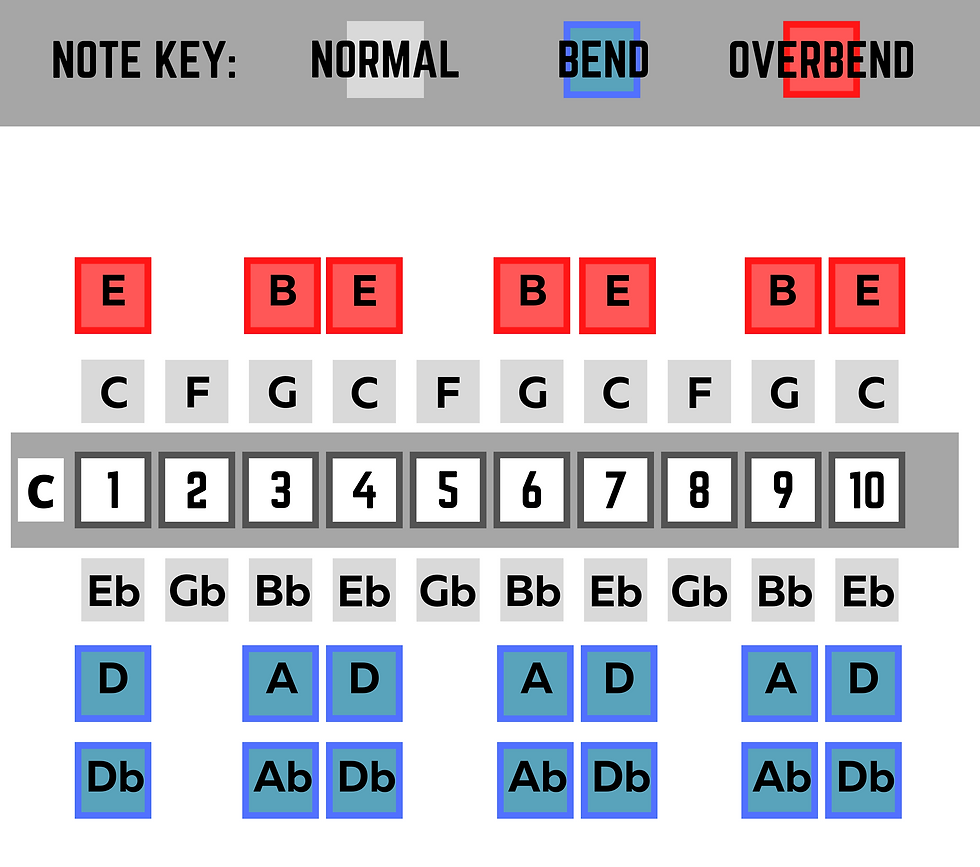
The Hohner Pentaharp is a modern tuning designed to make blues playing much easier right from the start. It’s based around the minor pentatonic scale. Many “wrong” notes are removed so you can improvise freely with less risk of clashing notes.
You can see the consistency of note layout on the diagram - the same note pattern the whole way up and down the instrument.
Features of the Pentaharp
Easy minor pentanic scale
Blues scale with just one bend
👉 Best for:
Absolute beginners who want quick wins
Casual players focused purely on blues jamming
Learn more about the Pentaharp → Intro to the Hohner Pentaharp
If you'd like to buy a Hohner Pentaharp harmonica, here are some Amazon links (I receive a small commission at no extra cost to you if you buy through one of these links):
Open Minor Tuning

Open Minor is a harmonica tuning I have seen Richard Gjems play nicely. It uses the standard Richter blow reeds and the draw reeds of the Natural Minor. This essentially makes it a Natural Minor with the two, five and eight blow tuned up a semitone. It means you have the major chord when you blow, which combine nicely with the minor chord on the draw.
4. Modern System Tunings
Wilde Tuning

This tuning was designed by Will Wilde to play intricate and powerful blues-rock solos. The altered higher notes make scales and bending more intuitive. One neat thing about this tuning is that all the bends are on draw notes, and there are only overblows (no overdraws) meaning you have a kind of consistency across the full range.
👉 Best for: blues and rock players progressing beyond basics
You can order Wilde-tuned harmonicas from the Seydel Store.
Brendan Power's Harmonica Tunings:
One of the world's greatest harmonica tuning designers is Brendan Power. We looked at his simple Paddy Richter tuning earlier. He has come up with dozens of alternate tunings over the years. These are a couple of his most popular and enduring ideas:
To explore more of Brendan's inventions, check out Inside Brendan Power's Harmonica Factory
PowerBender Tuning

The Power Bender to make the "juicy" notes much easier to obtain further up the harp. Notice that there are no blowbends or overdraws, simplifying the techniques involved to get the "missing" notes.
👉 Best for: expressive blues and easy jazz playing
You can order PowerBender harmonicas from Brendan Power's website.
PowerDraw Tuning

PowerDraw tuning uses the familiar holes 1 to 6 of standard Richter tuning. All draw reeds are higher than blow, allowing for much more draw-bending in the higher register.
👉 Best for: distinctive draw-bending blues
You can order PowerDraw harmonicas from Brendan Power's website.
5. More Specialist Alternate Tunings
Spiral Tuning / Circular Tuning

Spiral tuning is also known as circular tuning and I have seen it called "Melody King" as well. It is actually a principle for arranging notes, rather than a specific tuning. The idea is to arrange a scale in a blow-draw pattern without discontinuation or duplication, so that you can play it smoothly. Notice how the note layout flips between blow and draw from one octave to the next - hence the names "spiral" and "circular".
In theory you could create a spiral tuning for any scale. In the diagram I have drawn up a major scale version of the spiral tuning system. This takes you straight up the diatonic major scale, with the draw note always higher than the blow. It provides semitone draw bends across the range and overblows from holes 1 to 10.
Pat Missin says that Mike Photis was probably the first person to create harmonicas with this tuning in the 1980s.
Features of spiral tuning:
Designed so scales flow smoothly across the harp
Reduces directional "jumps" in playing
👉 Best for: players frustrated with Richter's irregular layout
Semi-Spiral Tuning

Semi-Spiral tuning is kind of a mashup on standard Richter and full Spiral tuning. I've never played one but it looks kinda fun!
Solo Tuning

"Solo tuning" is the standard note layout for chromatic harmonicas, but it is sometimes applied to diatonic harmonica as well. The scale runs out at the top of the harmonica so you have a limited range, but you can apply your chromatic moves to it, and get a full major scale in two octaves without bending.
Diminished Tuning

Diminished Tuning uses a symmetrical system - every draw reed is a tone above its corresponding blow reed, all across the harp. This means there is just a semitone draw bend on each hole. Note that there are no overbends shown because they are made redundant by the chromatic capabilities of this tuning.
The idea is that you can transpose licks into different octaves with ease. This makes jazz solos much easier.
Since the scale runs out at the top of the harmonica, it would make sense to order a 12 hole version of this tuning (or even a 13 hole - which you can buy from Brendan Power).
Features:
Fully repeating interval structure
Highly logical for theory-based playing
👉 Best for: jazz and advanced improvisation
For more information on diminished tuning, check out this book: Exploring the Diminished Harmonica by Jason Rogers
Augmented Tuning

Augmented tuning was created by folk harmonica player Eric Chafer. You can play full chromatic scales using only draw bends - no overblows needed. Obviously you need great control of bends to play it well. The chords sound kind of Asian or Spanish.
Features of Augmented Tuning:
Symmetrical structure
Unlocks unusual harmonic ideas
No need for overbends
👉 Best for: experimental and jazz players
Mixolydian Tuning

This tuning is built for playing the mixolydian mode in 1st position (the major scale with a flattened seventh degree). Holes 3 and 7 are lowered a semitone from standard tuning. It allows for new chords and different octaves from standard tuning.
Dorian Tuning

With Dorian Tuning, holes 3 and 7 draw tuned down a semitone so you get the Dorian mode in 2nd position. This is very similar to Mixolydian tuning, but here you have to bend hole 2 draw to get the F note.
Bagpipes Tuning

Bagpipes tuning is used by James Conway and it's pretty crazy! It creates a pipe-like drone sound by duplicating holes 1 and 2 blow on the draw reeds. This means you can play a constant chordal drone while tongue blocking to play a melody out of the right side of your mouth. Holes 3 and 7 draw are also lowered a semitone from standard tuning.
Which Harmonica Tuning Should You Choose?
Style of Music | Best Harmonica Tuning |
|---|---|
Classic Blues | Richter (standard) |
Irish Folk Music | Paddy Richter / Easy 3rd / Solo |
2nd Position Major | Country / Melody Maker / Major Cross |
Minor Scales | Natural Minor / Harmonic Minor |
Blues Rock | Wilde Tuning / Pentaharp |
Distinctive Blues / Jazz | PowerBender / PowerDraw |
Jazz / Experimental | Augmented / Diminished / Bagpipe |
Note: Not all these harmonica tunings are available "off-the-shelf" but Seydel do now offer a custom service where you can order any tuning you like via the Seydel Online Configurator.
Frequently Asked Questions (FAQ)
What is the standard harmonica tuning?
The vast majority of diatonic harmonicas use Richter tuning, which is designed for chords, bending, and blues playing.
What harmonica tuning is best for beginners?
Start with Richter tuning. It’s the most widely taught, and almost all lessons and songs are based on it.
What tuning is best for playing melodies?
Paddy Richter is one of the best options because it allows you to play major scales without bending.
What tuning should I use for blues?
Stick with Richter tuning, or try Wilde tuning if you want a more intuitive layout for blues-rock improvisation.
What is the best tuning for minor keys?
Natural Minor tuning is the easiest way to access minor sounds without advanced techniques.
Are alternate tunings worth it?
Yes - but only after you’re comfortable with standard Richter. Alternate tunings solve specific musical problems rather than replacing the standard.
Do professionals use different tunings?
Absolutely. Many advanced players use tunings like PowerBender, Circular, or Wilde to suit their style.
How many harmonica tunings are there?
There are dozens, but most players only use a handful regularly. This guide covers the most important and widely used ones.
Why should you use alternate harmonica tunings?
Special tunings exist to solve specific problems.
On a standard Richter-tuned harmonica, certain things can be challenging:
Playing smooth melodies without bends
Accessing clean minor scales
Navigating the layout intuitively
Different tunings adjust the note layout to make these things easier.
For example:
Paddy Richter makes melody playing more straightforward
Natural Minor gives you instant access to minor sounds
Country tuning simplifies major playing in 2nd position
In other words, alternative tunings don't necessarily replace standard Richter - they optimise the instrument for particular styles or goals.
Final Thoughts
Harmonica tunings aren't just technical variations - they’re different musical systems.
The right tuning can:
Remove technical barriers
Open new styles instantly
Completely change how you think about the instrument
If you've only ever played Richter tuning, trying just one alternative can be a major breakthrough.
Ready to Make Real Progress on Harmonica?
Understanding different tunings is powerful - but the truth is, most great harmonica playing still comes back to mastering the fundamentals on a standard Richter-tuned harmonica.
That's exactly what everything inside my Online Harmonica School is built around.
Rather than jumping between lots of different systems, you'll learn how to:
Get full control over bends, tone and timing
Understand positions so you can play in any key
Build real musical skills that transfer across styles
All using a standard harmonica (the one you probably already own).
Once you have that foundation in place, exploring other tunings becomes much easier and far more meaningful.
👉 If you want a clear, structured path to becoming a confident harmonica player, you can Explore the School Here.


.png)